


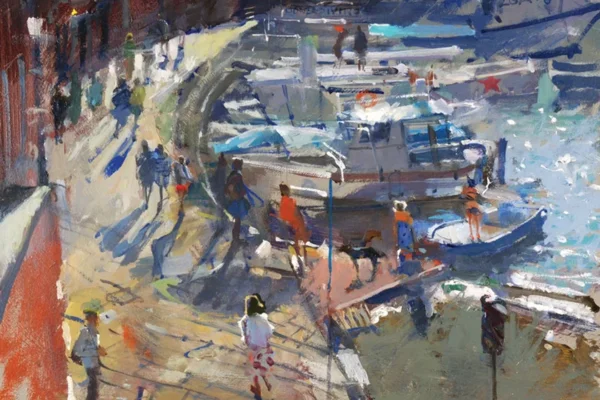
Waiting for the Boat, Isola di Ponza, oil on board, by Richard Pikesley
Richard Pikesley, a holiday tutor, answers the most frequently asked questions about getting the most from a painting holiday.
Two key benefits of a painting holiday are taking a break from the daily routine and spending time with fellow artists. They also provide a valuable and focused learning experience.
I always enjoy travelling with other painters and my trips have taken me around the world. I teach through demonstrations and group discussion, but my students do much of their real learning through one-on-one instruction. I try to keep tabs on where everyone is working and I drop in on them at just the right moments through the day.
Looking for more painting holiday advice? Check out our collection of handy guides with top tips from artist tutors.
In the evenings we gather for informal conversation and share our experiences of the day. There may be an opportunity for a bit of teaching if a topic comes up that concerns several artists. This part of the day is always a valuable part of the experience.
We enjoy relaxed, social dinners where we can all get to know each other. I also use this time to make sure everyone knows what to expect on the following day. A more relaxed approach allows students to develop at their own pace. I’m always amazed at the roomful of paintings and drawings in our exhibition on the final evening.
Your painting holiday questions answered
Q. What kit should I take on my painting holiday?
A. These days I concentrate on keeping the weight and the complexity to a minimum. My pochade box holds everything, including a range of sizes and shapes of painting boards. A lightweight folding fishing stool completes the kit.
I generally take my oil painting kit and have a lovely old half-box easel that holds loads of brushes and tubes. Importantly, it has cranked hinges on the folding palette, allowing me to fold it up to move without squashing the paint.
I like using a pochade box and, depending on the location, sometimes take this instead of an easel. Without the spread of an easel’s legs, it’s easier to work discretely and to find somewhere to tuck yourself in. A little folding stool allows me to work on my lap, or I’ll find a wall to balance the box on and work standing up.
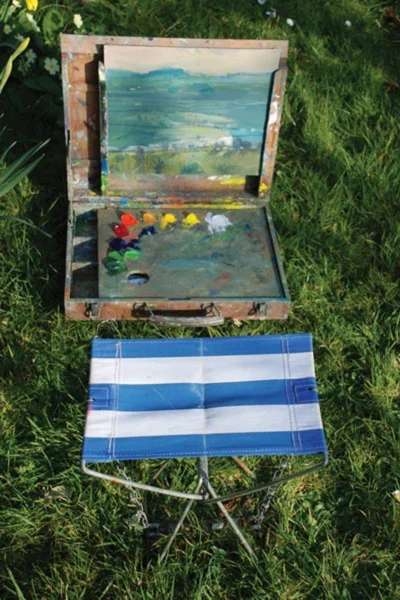
I generally take lightweight boards to paint on rather than canvases, again to save on bulk. I use sketchbooks most days, and away from home I’ll have two in my bag. If I’m using watercolour I can alternate between books to avoid turning a page and blotting a still wet study
My preferred sketchbooks are robust hardback books with HP paper. They take a lot of punishment and let me use pencils and pens in the same book as watercolour. Some tubes of watercolour and white gouache plus a few brushes and pencils completes my travelling kit.
If your main interest is watercolour the materials and equipment will weigh less. Paper pre-cut into quarter sheets will be enough for most needs. By taking thicker paper that won’t need stretching, a heavy drawing board becomes unnecessary. Lightweight ply or even foam core board cut just a little larger than your paper will be robust enough.
Remember, if you are travelling by air, you must pack all your painting equipment securely in your hold luggage.

Q. I've never worked with other painters, will I like it?
A. I’m pretty sure you will - it's like suddenly having access to lots of different view points. Painting can be a rather solitary business. An organised trip can still allow you to ‘do your own thing’, but also share in your fellow painters experiences.
Getting together in the bar at the end of the first day is always a good moment. We all learn so much from seeing the world through all those extra eyes. Depending on the location, I try to stay in touch with all the painters, dropping in on each several times a day. The one-to-one conversations with the subject in front of us and time to talk can be genuinely useful.
Q. How do I choose what to paint?
A. You will know what to paint when you see it. I have a painting friend who says he just walks about until something winks at him. However, beware of just wandering about aimlessly.
Years ago, before my first trip to Venice, a friend said I shouldn’t shy away from painting all the obvious subjects. I distinctly remember a sort-of-crisis when I decided to explore a little further afield. Convinced there might be something even more amazing round the next corner, I wasted a whole day.
These days I often focus on a single location. Painting many little oils and watercolour notes from the same spot and exploring the changing light. Between paintings, a careful line drawing, developed throughout my stay will make the subject ‘mine’. I then also have an invaluable reference for studio work.
Painting in a busy public space can be a little daunting. It always surprises me how quickly even novice painters get over any sort of stage fright. Setting up just a few feet away from the flow of pedestrians means you can generally work in peace. Those who do come closer will often wait for you to take a break before starting a conversation.
Q. In rapidly changing light, how do you get enough information?
A. When I see something marvellous I want it immediately! My instant response would never give me enough information to take back to the studio to build a bigger painting. The apparent solution of just keeping going on the spot doesn’t work either. A whole day’s work on one piece will result in a confusion of light effects that will cancel each other out.
I’m definitely a heart-before-head person so my fast study will usually be my first response. Often a single viewpoint will offer a progression of ideas through the day. Several quick studies made one after the other will capture changes in a view.
With two or three of these quick studies in the bag I can go and have some lunch and switch off for an hour. Later I’ll return to the same spot and make a careful line drawing that won’t be light dependant. I can dip in and out over my time in that location and add a little each time.
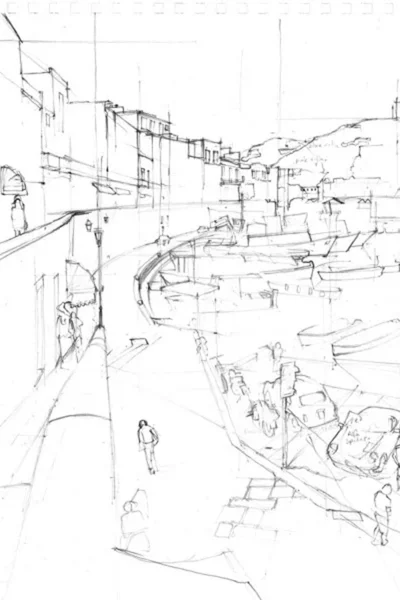
These drawings aren’t pretty but they are valuable to me. They give a clear record of where all the edges fall and how everything fits. A single drawing like this will give me the back-up information I need to complement the painted studies made from the same spot.
The main thing is simply to look and make some sort of visual record. If you find your drawings and painted notes aren’t enough, scribbled notes can give you another layer of information. Later these will help to stimulate your visual memory. You are less likely to form good visual memories if you rely too much on a camera.
Q. How do I carry wet paintings, and get them home safely?
A. If you paint in watercolour, pastels or acrylics this is unlikely to be an issue. You can pack your finished paintings in the same way as your blank paper was for the outward journey.
For oil painters though, a bit more planning is needed. For both canvases and boards it’s helpful to work on the same size as this makes carrying the wet artwork much simpler. I glue matchsticks, close to the edge onto the back, one in the centre of the short side and two on each long side.
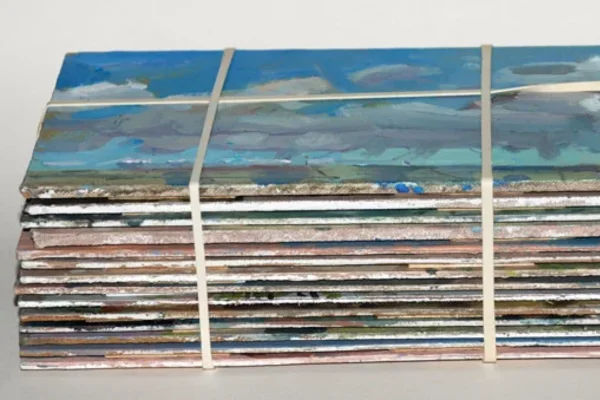
At the end of the day, or when packing, you can stack your paintings and secure with rubber bands. As long as the top is either unpainted or dry they are easy to carry. The matchsticks will only mark the edge of each board and you can easily retouch this. You can pack pairs of canvases face-to-face separating them with canvas pins before securely tying with string.

Richard Pikesley studied at Harrow School of Art, Canterbury College of Art and the University of London Institute of Education. He is a past president of the New English Art Club and a member of the Royal Watercolour Society. Richard has exhibited widely and won many awards. See more from Richard on Instagram.
Comments
Login or register to add a comment
No comments