


I was drawn to the Daniel Smith range of watercolours when I became aware of both the striking qualities of the granulating properties of many colours, and also their amazing vibrancy. Whilst I wished to retain as a basic palette those traditional colours, such as burnt umber, cobalt blue, cadmium red, yellow ochre and French ultramarine, the latter itself a strong granulating pigment, I threw myself wholeheartedly into experimenting with the new colours. As there were 237 colours in the range when I began this, I obviously had to limit myself to a certain number. This expanded even further as Daniel Smith brought out more colours.
Explore the Daniel Smith Extra Fine Watercolour range
Granulations
Granulations are those particles that emerge from a watercolour wash, some just tiny speckles, some larger blobs and others appear in organic pattern streams, depending on how you work. Granulations can be especially effective for rough mountainsides, pasture, foliage, rough walls, beaches, and a host of other features while conveying a textural quality. In a quiet area of a painting, such as a simple sky, granulations can introduce an element of interest in what otherwise might just be a flat wash. You can emphasise granulations by using a paper with a rough surface, keeping the work at a shallow angle. Pigments vary considerably in the strength of granulation; sodalite genuine, for example, being far more prominent than the gently granulating lavender, which is a useful colour for skies. Many of the Daniel Smith watercolours embody the most fabulous super-granulating effects.
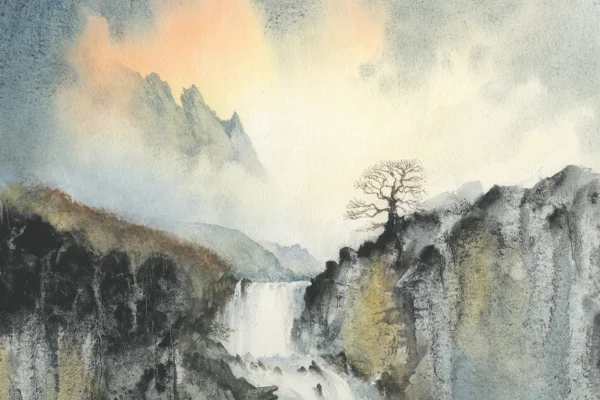
Gathering Mist, David Bellamy
I began painting Gathering Mist, by laying on Naples yellow in the sky then quinacridone sienna above this, to run down into the yellow. The distant pinnacles were rendered lightly with lunar blue and, when dry, I suggested the darker parts of these ramparts with a slightly stronger version of the same colour. When this had dried, I re-wetted the whole sky and laid a strong wash of lunar blue over the upper parts, bringing in tails of clouds from the right.
The falls themselves were shaped by strong applications of lunar black, with yellow ochre and lunar blue splashed in, in places. I immediately dropped in granulation medium to create the vertical drippings of speckles and organic dangling shapes. The more granulation medium applied, the more the effect produced the speckled effects. Finally, I added the tree and shapes into the rock structures with a fine No. 4 sable brush.
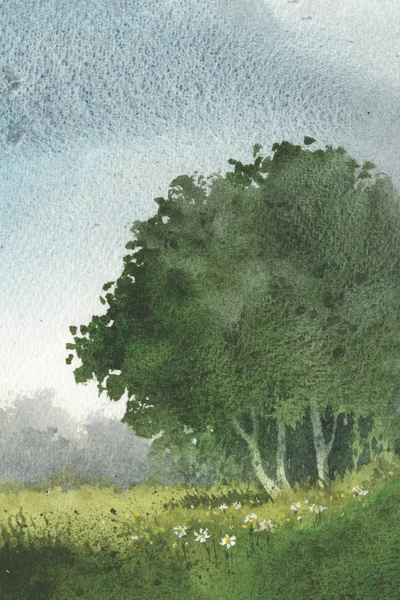
Summer Trees, David Bellamy
Summer Trees illustrates the useful effects of using green appatite genuine for summer foliage and vegetation. In the right-hand foreground you will see how green appatite genuine on its own produces interesting granulations, while in the tree foliage I added Zoisite genuine is a grey-green colour that granulates strongly and in some places it induces dark blobs. These colours can create effective foliage and vegetation without any need for further work on the passage. The sky was painted with lunar blue and shows how a simple granulating wash can work well in a sky where you don’t want detail, just a hint of interest.
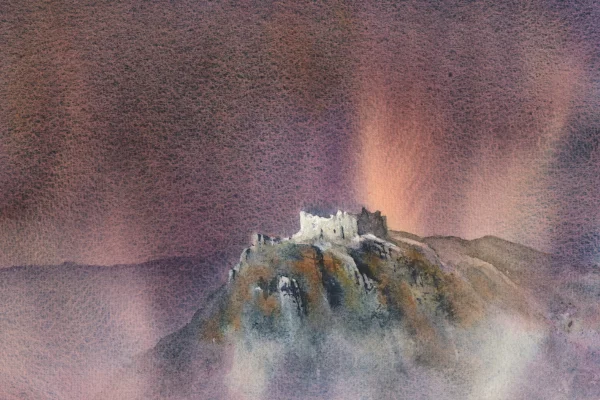
Storm over Carreg Cennen, by David Bellamy
Initially, the sky in Storm over Carreg Cennen was painted with Naples yellow, Aussie red gold and quinacridone sienna and allowed to dry. I applied masking fluid over the left-hand ramparts of the castle. Then I painted the background left-hand ridge and let it dry before completely wetting the paper and pouring a fluid wash of moonglow – a lovely plum-coloured pigment – from a container. This wash flowed down rapidly to create a dramatic effect, and often with this method control can be lost.
I would have liked to have retained a bit more of the Aussie red gold and quinacridone sienna, but the wash reveals lovely granulations and a simple, but dramatic sky. The wash was brought down over the castle and left-hand ridge. Once this was dry, I added detail to the castle and crags.
Colour Vibrancy
Daniel Smith has searched the world for new minerals, and technology has brought about more vivid and exciting colours, thus introducing new opportunities for artists. The colours mentioned here are ones that I especially like, constantly use and recommend with the more traditional palette as mentioned above, although I do use many other Daniel Smith colours, such as transparent red oxide, which has largely replaced light red in my palette, because of its transparency and vibrancy. The cadmium colours are actually hues so, if you are allergic to cadmium, these would be a great alternative.
Introducing new colours to your existing range is always an exciting prospect, but rather than doing this wholesale, it is better to introduce a number at a time and get to know those colours and their properties thoroughly. The colours used in this article will give you a great start.
Get your Daniel Smith Extra Fine watercolours today