


The range of Edding Acrylic Paint Pens comprise 26 highly pigmented, water-based coloured pens, which are low-odour and lightfast. They are easy to use, and clean to work with on paper and canvas, enabling the widest range of creative expression, limited only by your own imagination. Activating the pens is simple: first shake with the tip facing down then gently pump the tip on a piece of paper to encourage the ink flow.
While the pens are suitable for many supports, I found paper and canvas the two I favoured. Most paper weights and surfaces are suitable, and I first selected one of my favourites, Hahnemühle Bamboo Mixed Media paper, to work on, and chose two brush sizes of 2/3mm and the wider 5/10mm widths.
Explore the range of Edding Acrylic Pens
Using a direct approach with Edding Acrylic Pens
My first approach was to draw directly onto the Hahnemühle paper with the fi ne tip pen. Testing these, I immediately became aware of the way the high pigmentation gives either a strong colour value that jumps off the page, or a light and so value, similar to watercolour painting.
Choosing the technique that would give me the stronger colour values (direct application with pen on paper), my first work was a traditional still-life composition. Starting with the rich red apple and the pen’s larger tip, the red was layered to establish lighter and darker tones while retaining an unpainted area of white for the strongest highlight. Later a white pen was used to soften back the secondary highlights. Other colours were added as needed for the ochre area around the stem and the dark stem itself. Using the pens this way, one colour can overlay and block out any previous colour.
The bananas were painted in the same way, whilst the grapes had a very different approach. Here I layered colours from light to darker and blended them while still wet with a water brush. This technique also worked well on the blueberries. Finally, the deep blue was applied, with the colour layered until I considered the right depth of tone was achieved.
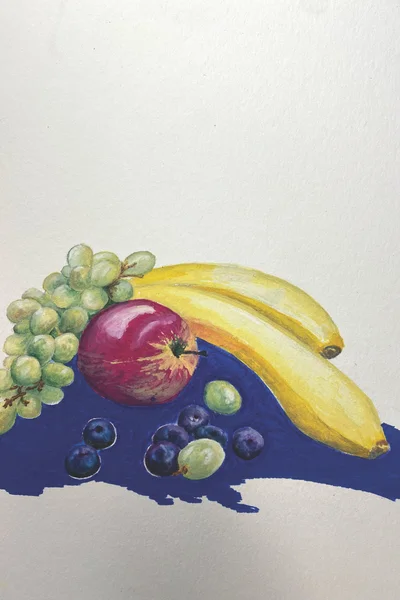
Still life, Edding Acrylic Paint Pens on Hahnemühle mixed media paper, 10¾x8in. (27x20cm)
Wet-on-wet
Having recently returned from tutoring a painting holiday in Scarborough, the powerful image of the castle standing high on the cliff was very much in my mind and I selected it for my next experiment with these pens. A quick pencil outline of the ruin established the design. I then wetted the paper around the structure and, with a light touch of the tip of the pen on the paper, I flooded in the colours. If you catch the paper too firmly, the colour may be stronger than you wish. In this case, I added water before the colours dried, to help it spread and become lighter.
Moving on to the ruin itself, the outline shape was drawn with a fi ne tip pen and, while still wet, I touched it with a water brush to allow flooding across the stone work. This technique was also used through all the building ruins, walls and grassed landmass areas, strengthening and lightening the tonality as needed by dilution with the waterbrush.
In the near foreground, a liberal line of water was laid on the flat paper then touched firmly with the chosen colour and, while still wet, blown upwards to allow random shapes of grasses to develop. It took several attempts with layering one on top of another to achieve this rather nice effect.
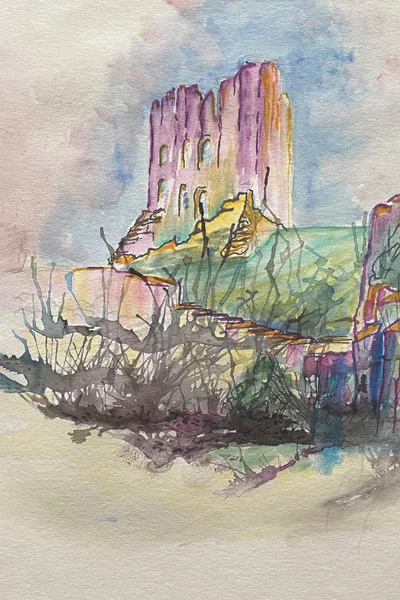
Scarborough Castle, Edding Acrylic Paint Pens on Hahnemühle mixed media paper, 13¾x11¾in. (35x30cm)
Contrasting texture
Having now developed several successful techniques for working with the Edding Acrylic Paint Pens I looked for another image to show a different style. Local to my home and studio in Cornwall is the well-known fishing harbour of Padstow. In this work, I wanted to mix both the strong depth of tonality often associated with acrylic and the softer tonality usually associated with watercolour to show the diversity of the pens.
To paint Padstow Harbour, I used many of the above techniques, beginning with a pencil drawing then adding wet-in-wet flooding for the light, watery tonal areas, then layering of the same colour to deepen tonality, and layering other colours to alter areas.
Finally, I drew with a fine point pen the shapes of the movement of the water as wind rippled the surface, which were then painted into in some cases for effect.
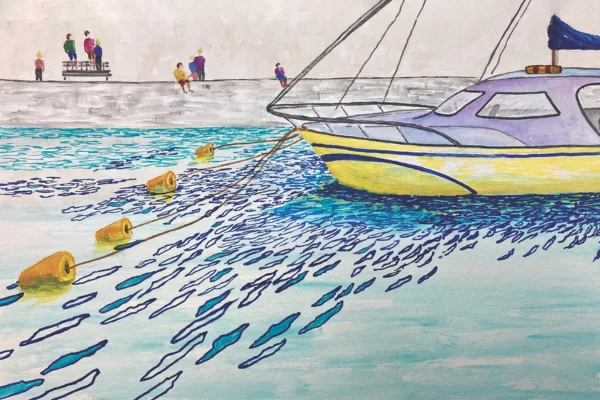
Padstow Harbour, Edding Acrylic Paint Pens on Hahnemühle mixed media paper, 10½x12½in. (27x42cm)
Working on canvas
This final artwork shows a sunset at Polzeath Beach, which was painted on stretched canvas. The aspect I noted most when working on canvas as opposed to paper was the different way the paint flowed when working. On canvas, drawing directly with either size pen tip and building up tonality layer on layer was similar if not quite as direct as on paper. When switching to the lighter tones, applying water first and flooding colour into it, was not as effective. I tried two alternative techniques. The best way I found for these areas was to push the tip of the pen onto a ceramic surface to produce a small puddle of ink and use as I would paint. You could also try lifting the colour from the large tip pens with a waterbrush then paint on to canvas. The dilution here was far greater, giving control of depth of colour. Using this technique and layering very subtle reflections of light dancing across the waves can be achieved.
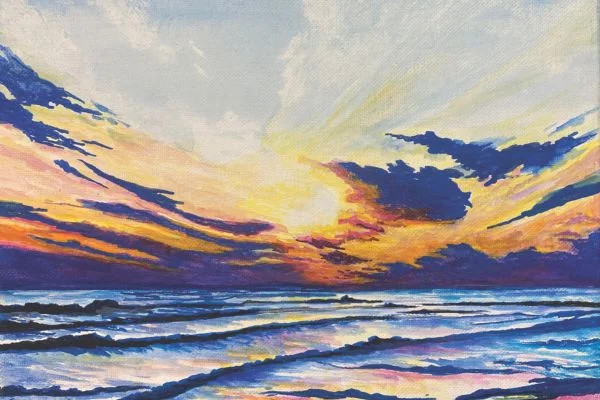
Sunset over Polzeath Beach, Edding Acrylic Paint Pens on stretched canvas, 10x11¾in. (25x30cm)
I hope you give these acrylic pens a try. It’s well worth experimenting with techniques and subject.
Get your Edding Acrylic Paint Pens today